

Sabzi ~ Persian Fresh Herbs
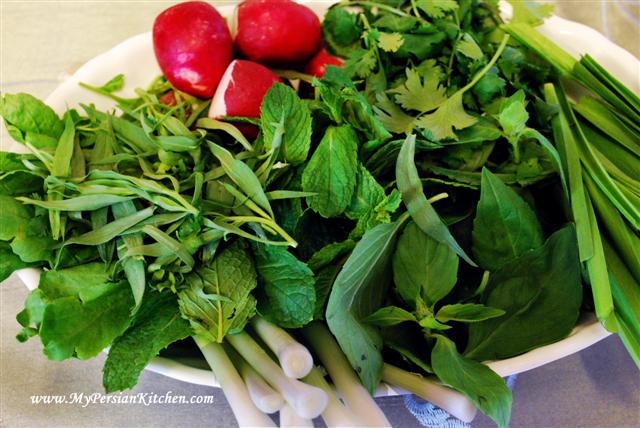
I was introduced to Sabzi as a child when I lived in Iran. Dare I say, it is a given that I love it and don’t find it to be a strange addition to the table. Sabzi so deliciously refreshing especially when you just take a handful and put it in your mouth. I love how the different flavors get mixed in together with the taste of the rest of the meal.
I am always amused at the way in which people react to Persian Sabzi. As you may have noticed I, for the most part, have stories that go along food that I love to share. I have two humorous ones for Sabzi. I humorously call these “West meets East” moments!
The first story involves one of my childhood friends Nader. About twenty five years or so ago, one fine day Nader, yours truly, and his sister Layla were called by adults as it was lunch time. Us kids always ate in the kitchen while the adults ate in the dining room. As a child I found this rule to be so lame; yet now, as an adult I can totally see the reason. We were three obnoxious kids. Nader was the rambunctious boy, I was the shaytoon, mischievous, tomboy, and well Layla was the calmest out of the three and definitely a girlie girl. In their kitchen they had this really awesome pull out table that rolled in and out of the wall unit. We had just rolled out the table and sat down when Nader was asked if he wanted some Sabzi. The answer that came out of his mouth was hysterical and his expression was priceless. Mind you were were all 10 or less years old at the time. He said something along the lines of:
“Mica sono un’asino? Gli asini mangiano l’erbetta.” What am I a donkey? Only donkeys eat herbs!”
Oh how I laughed! Even though I was only a couple of years older than he was, I knew that he had no idea what he was passing on because, having grown up in Italy, he was not used to the way Persians ate herbs with their meal.
I didn’t think anything could top that until…I took The Sous Chef, when we first met, with me to a gathering where Persian food was catered. There was some delicious Kabob, rice, and a huge and inviting platter of Sabzi. We all filled up our plates and went to sit at a table. Both The Sous Chef and I were busy conversing with the people sitting on either side of us while eating. Once the meal was over I asked him how he liked Persian food, as it was his first time having Persian Kabob.
“Everything was really good. But the herb salad needed some dressing. I looked around it but there was no dressing.”
“What herbs salad, I didn’t see one.”
“Well there was this huge platter with all kinds of herbs, radishes, and green onions.”
“Ohhhh, you mean Sabzi! There is no salad dressing for that. You just eat the herbs with you meal” Do you know how hard I had to try to contain myself from laughing out loud? VERY HARD!
Oh how he cracked me up!
Moving right along, here is a tutorial on how to clean and present Persian Herbs.
Cast of characters with their corresponding names in Farsi:
Persian Basil ~ Reyhan
Mint ~ Nanaw
Cilantro ~ Geeshneez
Tarragon ~ Tarkhoon
Persian Watercress ~ Shawhi
Green onion ~ Peeazcheh
Chives ~ Tareh
Radish ~ Torobcheh

Look at these beauties! I always buy my herbs from my local Persian Store.
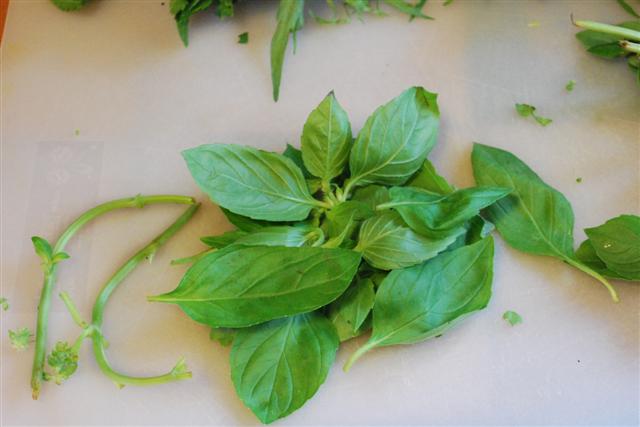
Remove the top portion of each Basil then removed each leaf from the bottom part and place aside. Please note that Persian Basil tastes and smells different than Italian Basil which is the kind that most people are used to. I would say that Persian Basil is a cross between Thai Basil and Lemon Basil.
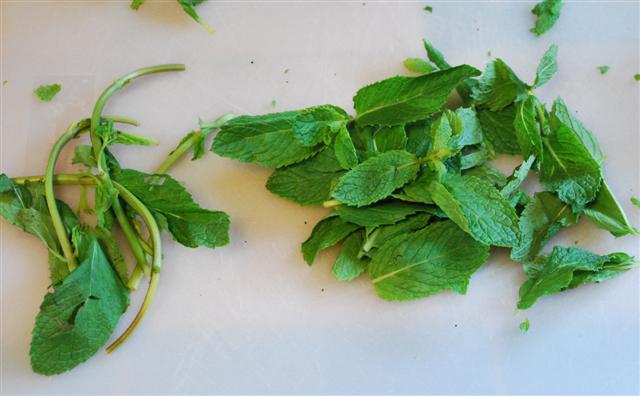
Do the same thing with the mint, removing the top part leaving it intact and then removing the individual leaves.
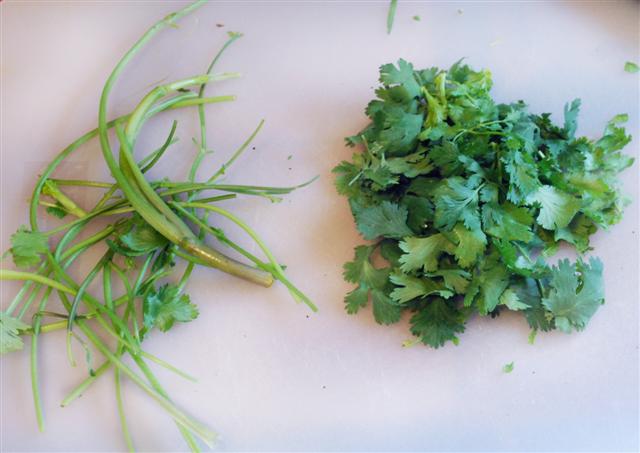
With cilantro you can either remove all leaves, like I do, or just cut off the bottom part of the stem that is thicker and tougher.
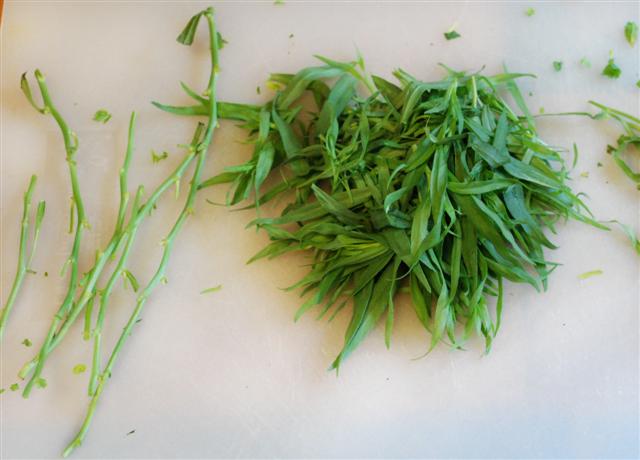
Remove all the leaves from the Tarragon’s stem.
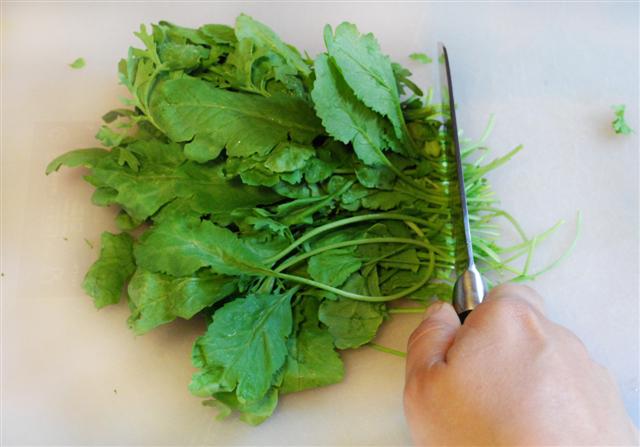
Cut the bottom part of the watercress’ stem.
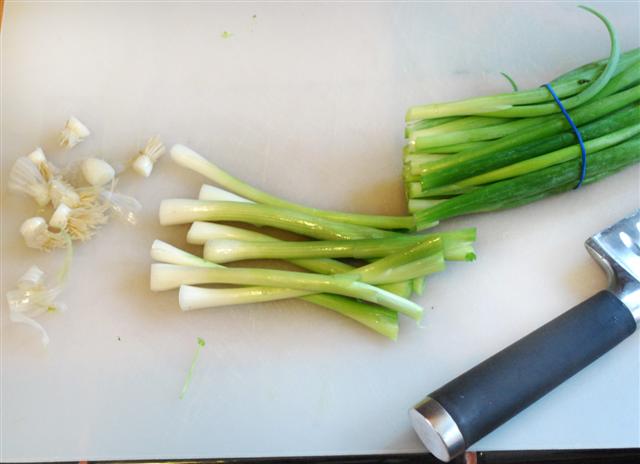
Remove the top end of each green onion and also cut just around the portion where it starts splitting off.
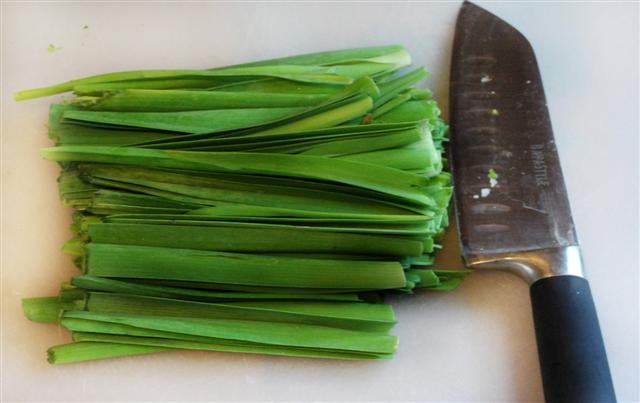
Cut off the dried up ends of Chives. This means a small portion off each end.
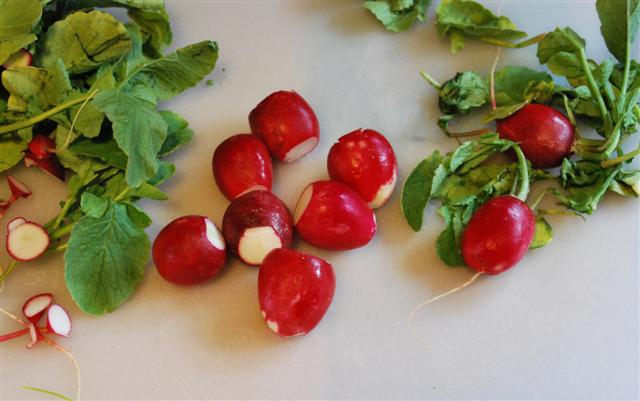
Cut off the top portion of the radishes. You can either cut the leafy part or them on. Some Persians like to eat the leaves. You can also get creative with your radishes, you can make small incisions around them and place them in a bowl of water for about one hour. The parts with the incisions will open up making the radish look like a flower.
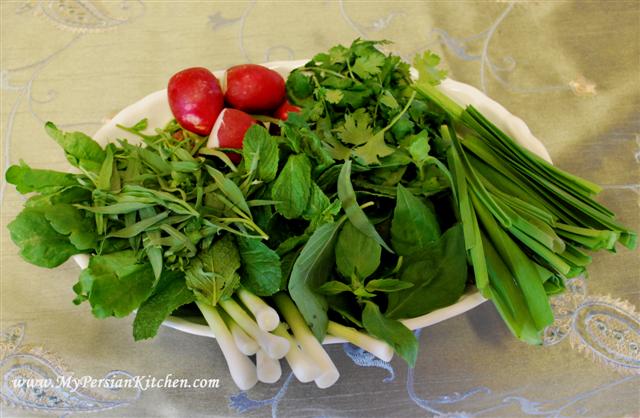
Arrange your herbs in a dish. A couple of things, you may choose to mix your herbs together or place them like I did. It i completely up to you. Also, you can either wash your herbs before or after cutting them. I personally like to wash them after I clean them up.
Important note, if you have leftovers place them all in a lightly damp kitchen towel or paper towel. Put your little bundle in a zip lock bag and keep in the fridge. Note that they will last longer this way, but no more than a few days.


November 5, 2009
They look so fresh and crisp and tasty. Love the colorful photos.
LL
November 5, 2009
Fantastic Persian blog! I’m very glad I found you.
November 5, 2009
Lori Lynn, they are soo soo good! A bit of work to clean up, but well worth the effort!
Maninas, glad you found me! Please keep on coming back! 🙂
November 5, 2009
Love sabzi. Yours herbs look so beautiful!
November 9, 2009
Yum ! Yum !
December 5, 2009
i was looking for the receipe for ghormeh sabzi…and i couldn’t find it on ur site …. please could u tell me which herbs you use in the dish (apart from dried fenugreek which i know about already) and do u have to use boneless lamb? or any other meat would do?
thanks
December 5, 2009
Sum,
I have not posted Ghormeh Sabzi yet, but it is on my list. The herbs used are usually parsley, chives, and cilantro to the best of my knowledge. This khoresht is traditionally made with cubed meat. I have seen people make it with chicken as well, but I think it tastes much better with stewing meat or cubed lamb.
May 6, 2010
please put information in farsi because some computers does’nt have farsi
May 6, 2010
Ramez, unfortunately, I only have a fourth grade education in Farsi and writing my content in Farsi would take me forever. Sorry!
June 24, 2010
I love your blog. I’m planning to make the kuku soon with home grown yellow summer squash.
I’m wondering about a couple of your herbs. This is nitpicky details but I’m curious.
Do you use a specific type of mint?
Your chives look broad and flat, is that correct? I’m trying to figure out what they are. I’ve read of 3 types of chives.
The chives I know best have round leaves and pink/purple flowers in late spring.
http://en.wikipedia.org/wiki/Chives
While garlic chives (and maybe another allium that I’m not familiar with but have read about called leek chives) have broad flat leaves. My garlic chives have white flowers later in summer.
Or are your chives simply the tops of the green onions?
I’m so interested in the details and appreciate any you can offer.
June 24, 2010
momomom, good questions! The type of mint that I use is the ones that are found at the store and are simply named mint. The chives are a favorite in Persian cooking and they are indeed wider than the regular ones. A good substitute can also be the tops of green onions.
July 25, 2010
Hi where can I get the seeds to plant persian basil please
Thankyou
Tina
July 26, 2010
Christina, I have no idea as I have never purchased them before. You may want to look for either lemon basil seeds or holy basil online or at your local nursery.
August 12, 2010
Hi again,
I did indeed make the kuku and it was very good the first time when I made it with fresh squash. A later experiment with frozen (from my garden) zucchinni was … not so good. Lesson learned.
From what you are saying I think your chives are what I call garlic chives. Do they have a bit of a garlic like smell when crushed?
August 12, 2010
momomom. yes, they do have a hint of garlic, however, they are much wider than regular chives! 🙂
October 6, 2010
Oooooooooh, I know what that is! I too like to serve it with my dishes (as I grew up across the border from you and at about the same time I think), and for Americans this is unusual.
December 22, 2010
hello , I was wondering why I cant leave a comment or ask any questions on your site from tehran. I am in Britain at the moment , so I think it will work from here!
I am baffled and have a question about Chives, Tare is this the same thing because I have seen ”Tare faranghi” and I think this is the typical Leek what we eat in the U.k.? Spring onions are your ”pioz che” am I right? and is Water cress the same as Shahin? Because they look different in appearance?
Thanking you in advance and happy ‘Shab e Yalda”
Catherine.
December 22, 2010
Catherine, I don’t know why you are not able to leave a comment from Tehran, I have other readers who leave comments from Iran without any problems. Persian chive is tarreh, Tarreh faranghi is leek, green onions are piazcheh, and yes, watercress is shahi.
February 21, 2011
Is shahi same as upland watercress which has peppery taste.
February 22, 2011
Vilas, Shahi is cress and it is related to the watercress family. I hope this helps!
November 23, 2011
I am looking for shahi and Rehan (Iranian Basil) seeds, please do advise where can I find and order.
Thanks in Advance
November 24, 2011
Chris, you can probably buy both of them online.
April 8, 2012
Many years ago I came across a herb that was used in rice to provide a wonderful aroma. As far as my Farsi permits it sounded like “bar drang or barrang”. I cannot remember the exact name. I have not been able to find out more about it. Any idea what this herb is called in English?
Love your site and colourful pictures that spring out of screen.
October 31, 2012
As far as I can ascertain, true Iranian tareh is a variety of small leek with the botanical name Allium Ampeloprasum var. Persicum. It is not the same as garlic chives which are Allium Tuberosum, although the leaves of tareh are harvested in the same way that chives or garlic chives are here. Iranians refer to our bigger type of leek as tarreh faranghi which translates as “European leek”. Ordinary chives are Allium Schoenoprasum
The phrase “leek chives” is one that people often use when referring to Persian cuisine, but I am not sure that such a vegetable exists in the English language. It may be that it is just a name adopted here to describe tareh because we do not have any other way of describing it?
I have not yet found where to get tareh seeds in the UK. For this reason chives, garlic chives, or spring onions, etc., are often used as a substitute.
April 21, 2013
u just brought me back to my childhood
dastet dard nakone
April 21, 2013
Bruce, barenj is rice. You probably had the rice that was mixed w dill. It also comes mixed w barberries, lima beans, almond slivers. Persians are in my opinion masters of the rice world
May 6, 2013
I’m looking for the English name of a sabzi that is found in the north of Iran called Kootkootoo. Please don’t laugh at the spelling LOLL I don’t have a clue how to write it. It’s very fragrant and spreads like mint. Any ideas.
May 15, 2013
Maria, I don’t think I know what that is!
November 20, 2013
This blog is awesome! It really help me a lot. I love cooking and trying to be good in persian cuisine as i am trying soooo hard in speaking farsi.
@ maria, you wouldn’t believe that i love that sabzi as well, I’m from Philippines and married to a persian, currently I’m here in Tehran. My father-in-law is from shomal. When his sister came to visit us, she brought some of that veggie, since then i was looking for the English name of that. hehe, i believe its a relative of mint. i know it doesn’t help about your question but can’t help to comment, just wanted to share..
June 12, 2014
I’m delighted with your blog. I found it very useful and accurate. Your blog is decorated with clear great colourful photos. Thank you very much.
February 27, 2017
I’m a vegetarian American and every time I see the Sabzi (never knew the name for it), at my half-Persian fiancé’ family gatherings, I’m really relieved it’s like “Oh thank god some veggies” lol. I mostly eat this and rice and pickles!! I had no idea there were Persian meatless dishes until I found your blog! I grow all these things in my yard, they grow like weeds so I always bring fresh cuts for my father in law. I’m really greatful for the Persian love of sabzi bc his appetite for it helps keep my herb garden manageable 😛