

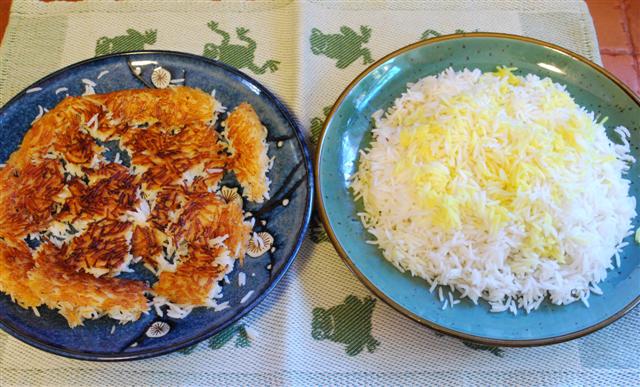


Last week before we took off to go to Seattle for our friend’s graduation I decided to make Baghali Polow, rice with fava beans and dill, because I had a sudden craving for it, but also because someone in the comments has asked about it. But then I realized something of grave importance. I have neglected to post about one of the key elements in Persian cooking: how to make Persian rice.
For anyone who has ever had Persian food, you know that the method in which the rice is made is very different than what you are used to, ya know, the basic 2 cups of water to one cup of rice, cook for 50 minutes or what not. Well that’s not how Persians roll when it comes to rice making. You read it right, rice making is a PROCESS. Most importantly, you can’t use any type of rice your little heart desires, you must use basmati rice.
It has taken me many tries in order to get it right. Not to say that it is awfully difficult, it is not, but you have to be shown how to make it right and know how long to cook the rice for. I have concluded that making Persian rice is an art.
So here is the way that I usually make stove top rice. Please make sure you make this type of rice in a non-stick pan.
*Important note for measuring purposes*
Please note that this recipe is good for two people. I only made this recipe for tutorial purposes. The amount of rice obviously varies depending on how many people you are cooking for. Additionally, measuring rice is different depending on whether a standard measuring cup is used verses the measuring cup that comes with rice cookers (Persian or non). A rice cooker measuring cup is equivalent to 3/4 of a standard measuring cup. I usually use the rice cooker measuring cup when cooking rice, and usually allocate about one cup per person.
Ingredients
2 cups of basmati rice (the equivalent in standard measuring cup is 1 1/2 cups)
2 tbsp of yogurt
1 pinch of saffron
1 pinch of sugar
salt
Canola or vegetable oil
Alrighty, let’s get started!

Measure out your rice and place in a bowl. Note the measuring cup in the above picture came with my Persian rice cooker and it is the one that I always use for measuring rice.
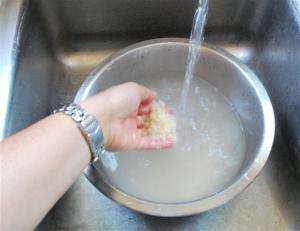
Wash rice a few times until the water looks clear. This is a very important step in cooking Persian rice. Essentially, what you are doing is removing the starch from the rice. I know someone (read: The Sous Chef) who always neglects to do this step. It is such an insult to our rice, I tell ya! The first time he told me that he made rice without washing it, I nearly spitted the rice out. Fortunately for him, we had guests, and I had to keep my horror and disappointment under wraps. But dip down inside I wanted to yell and scream profanities.
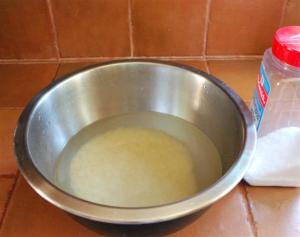
Add some salt and let the rice soak for a few hours. It is generally strongly believed that rice should rest over night for best results. Now, let me tell you, the world will not come to an end if you don’t soak your rice. If it did, then we would not be here, courtesy of yours truly.

When you are ready to cook bring 6 cups of water to a boil. I don’t like to take chances so my rule of thumb is 3 cups of water per cup of rice. You will be amazed how the rice soaks up the water.

In the mean time in a mortar add sugar and saffron and grind until saffron turns into a powder.
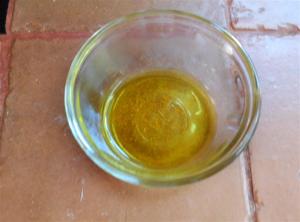
Once your water starts boiling, take 2 tbsp of the hot water and add it to the saffron and sugar powder. Then salt the boiling water.
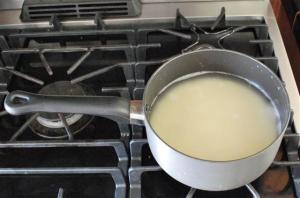
Think of this part of the process as cooking pasta. You salt the water, add the pasta, cook until done, and then drain. We do the same thing here: place the rice in the boiling water and cook for about 10 minutes. This is the first crucial moment of rice cooking. Make sure that you stir the rice a couple of times from bottom up during the cooking time. Once the 10 minutes are close taste your rice. It should be soft, not hard or mushy. It should be longer than it was before it went into the pot, but it should not be moments from falling apart.

While your rice cooks, place yogurt in a mixing bowl, add saffron water to it and mix well. Please note that it is best to not use yogurt that it is too sour for this recipe.
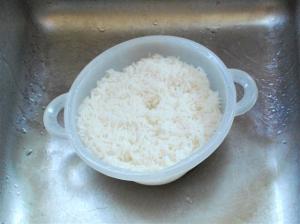
Once your rice is ready drain in a colander and give a quick rinse with cold water to stop additional cooking.
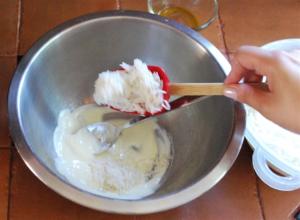
Add about 4 to 5 tablespoons of rice to the yogurt mixture.

Mix well together.

Add a very thin layer of water to the bottom of the pot. Essentially, what you are looking for is a thin layer that covers the whole bottom of the pot. Add oil, I would say for this recipe 1 tbsp, more if you are using a bigger pot. Give it all a shake so that the water and oil get a little mixed up. This my friends, it is the first step in making Tahdig.
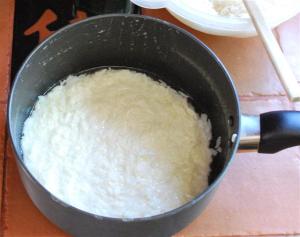
Cover the bottom of the pan with rice mixed with yogurt. You ask why we add yogurt and saffron? Because it makes really yummy Tahdig! Pile up the rest of the rice on top in the shape of a pyramid.
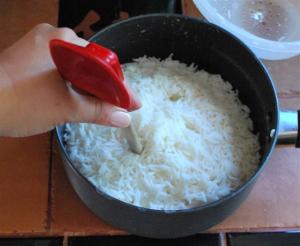
With the back of your spatula make 4-5 holes, making sure that you don’t go through the rice and yogurt mix. This is done for steaming purposes.
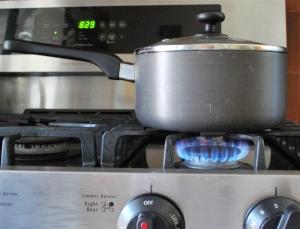
Cover and cook on high for 10 minutes, NO MORE THAN 10 minutes.
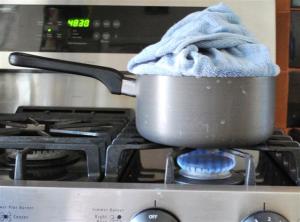
After 10 minutes place a towel over the lid of the pot, cover, and cook on medium low for 1 hour. At this point you are steaming your rice.
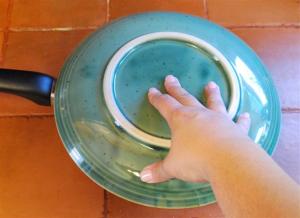
There are two ways to serve Persian rice. Here is the first way (my favorite way): Place your serving dish on top of the pot.

Flip the pot while holding the dish against it firmly.

Remove the pot and voila’! Look at the fabulous color of that Tahdig. Yummy!
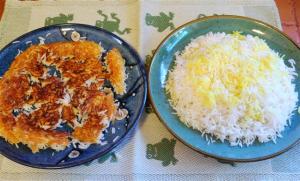
The second way of serving Persian rice is by plating the rice in a platter, then remove the tahdig and cut it in small pieces and placing it in dish. Usually when people plate the rice this way they will place some rice mixed with saffron on top for decoration purposes. This is really simple to do. Here is how you would do it.
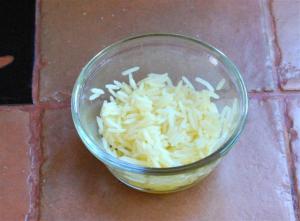
Instead of adding all of the saffron water to the yogurt, reserve about 1 tsp of it. Add a couple of spoons of rice and mix well. Place the mixture on top of the rest of the rice. Then proceed with the cooking process.

Once your rice is ready, remove the rice with saffron from the top of the pot and place in a bowl.

Plate the rest of the rice and then place the saffron rice on top.


January 5, 2012
I have been looking for a good rice and a good kebab and i found both on your blog! I can’t wait to try them both tomorrow night. I will definetly be adding your site to favorites! I love persian food. Do you have any recipes for the bread (kinda like nan?) i used to get it with the raw onion and butter at an old restraunt that is now out of business, and I dont even know what it is called! thanks, your blog is great!
January 6, 2012
Callie, I am glad I can be of help. I have not ventured into bread making yet….one of these days I will though!
January 16, 2012
What kind of yogurt do you use?
January 17, 2012
Ellen, any type of yogurt will work out.
January 28, 2012
I have asked my mom several times to teach me how to make good pollo with tadig while I’m away at college. She didn’t want me to “waste” my time making pollo every night. HA mom! Now what? I’m gonna make pollo with tadig everyday. Thanks My Persian Kitchen!
January 31, 2012
Soheil, ROCK ON!!
March 8, 2012
Oh dear….I am trying to learn how to make Persian rice for my Persian boyfriend who can’t stand my ‘sticky’ rice (to be fair to him – he does offer to cook the rice when we eat it!)
Tonight I set off the fire alarm after burning the rice during the 10 minutes on high – any suggestions about how to tell if you should turn the heat down before 10 minutes?!
March 8, 2012
Dee, oh boy! I suspect that you may have not had enough oil and water at the bottom of your pot and that’s why things got smokey!
May 25, 2012
Ever since I broke up with my Persian girlfriend, lets call her Farnaz, I realized that there was a void in my life. My days were dark, my nights were lonely. And I realized what this void was. Piping hot Persian rice with ghormeh sabzi. Orange rice, wild rice….tadiq…
My longing was not for her love. But for her persian rice.
And I am making it as I post this.
July 17, 2012
i followed this and under just burnt and i ruined my pan!!!! which was very expensive???!!!!
any suggestions with oil as i did use rapeseed as i always use that now instead of olive- should i of used veg oil?
x
July 27, 2012
Laura, I am sorry your rice burned. Grapeseed oil is a good option as it can tolerate high temps. There are a couple of things that may have gone wrong here. First thing is that maybe you didn’t have enough oil at the bottom of the pot. The second issue might be that the flame was too high. Make sure you set it on the lowest setting possible.
October 15, 2012
RE-POST BECAUSE I HAD COOKIES DISABLED
I just tried this. With India Gate basmati, after a three hour soak, it was already getting too soft after a six minute boil. For the tadig I put the pot on 5 (dead medium, electric stove) for ten minutes, and it was starting to smoke before the time elapsed. I don’t think I started with enough oil and water at the bottom. Sometimes due to the Leidenfrost effect, higher temperatures scorch less. I’ll have to experiment. People trying this need to realize you have experiment with the parameters a few times to get it right. A perfect crust is a gold star. You don’t get one on your first attempt.
March 8, 2013
Hello,
Is it ok to use some fresh lime instead of the dried limes called for in Ghormah Sabzi recipe?
Thanks.
March 13, 2013
Lesley, sure in the absence of dried limes, you can use the juice of fresh lime at the last few minutes of the cooking process.
March 17, 2013
I made Persian rice tonight, and the rice came out great but my tahdig is all soft and barely held together. I’m so sad that I don’t get any tahdig this time. Did I take the rice out of the pot too early maybe? This is my second time making persian rice and the first time the tahdig I got was great. Third time will be the charm I think! Thank you for the recipe.
March 18, 2013
Kayvan, it takes patience and practice! You probably didn’t cook the rice long enough or there was too much liquid at the bottom of your pot.
April 2, 2013
As an American I lived in Iran in 1975 and was a sous chef in an Iranian restaurant in 1986 in L.A., so we cooked ‘the rice’ several times a day. Usually we used lavash for the tahdig and no extra water or yogurt, just oil, with only a few minutes on high to get things going. Then it was down to low, not medium/low for at LEAST a hour plus. This technique takes and needs time and patience to not burn it and get a good steam and decent crust.
April 23, 2013
Thanks for the advice, I have tried many times to make Persian rice but always seem to end up with okay-tasting rice but no elusive tahdig!! I will try this method next time, thanks!!
April 29, 2013
THANK YOU!!! I have been begging my mom for years to just write this down for me. And she replies “just watch me do it”. I can’t begin to tell you how many times I’ve watched her do it and still can’t get it right. I can’t believe I just found your blog. Can’t wait to satisfy my craving of ghormeh sabzi on tahdig.
May 9, 2013
Hi there,
First off, I am in LOVE with your website. I have been begging my mom to show me how to cook. She says just watch me, add a little of this and if it tastes like this, you want to add that. 🙂 it never worked out. I have tried a few of your recipes and they all came out just right, even got the seal of approval from my mom. I still haven’t perfected tahdig yet. I was wondering what size pot you are using? I can’t seem to have enough yogurt and rice to cover the bottom. Also should the rice have a bite to it when we drain it. I’ve been experimenting with the time. 10 mins on my stove gives me mushy rice. Especially for some of the polow recipes.
Thank you again for a detailed and update blog. Love all the pictures and I look forward to some serious cooking in the next few weeks.
Gratefully yours,
Mondana
May 15, 2013
Mandana, glad to hear that you have been having success in your cooking. When you parboil rice it should be al dente. This means that it should be just tender to eat but not cooked all the way through. It doesn’t really matter what size pot you use, what matters is that you have enough canola oil at the bottom and just a bit of water enough to cover the bottom of the pot.
May 17, 2013
How can I use this recipe and make lavash tahdig?!
May 22, 2013
How can I use my Persian rice maker and have as good tahdig like the traditional tahdig with the yogurt?
I am an Iranian and I have learned a lot from you. Thank you
Goli
May 23, 2013
Goli, you can, however, you’d have to remove the rice from the rice cooker once all the water has been absorbed. Then mix rice, yogurt and oil together and add a little water to the bottom of the pot. Then pile the rice on top.
May 23, 2013
Ashley, here is the recipe for it: http://mypersiankitchen.com/tahdig-with-lavash/
May 27, 2013
I love your website! I’ve been looking to start making Persian food ever since my former mother-in-law first introduced me to it, but didn’t know where to start, so I’m so happy I found this website! I love tahdig, and she always made it with a non-stick pot, but I don’t own any non-stick cookware. I have stainless steel and cast iron. Could I make it in either of those, or should I buy a non-stick pot? If I can make it properly, I see myself making it pretty often.
June 3, 2013
Rachel, your best bet is a non-stick pot.
July 19, 2013
Dear Sanam ,
I found bumped into your website and love it so much! I am interested in cuisines of different countries. As I had several Persian classmates, they always say HOW GREAT their rice is and offered to cook rice for me one day..which never came true lol But now I can do by myself! Cant wait to try on this weekend. I am just wondering if the 6 cups of water (as u mentioned) is the standard measuring cup (250ml) or the rice measuring one? And if im making Polow rice, you said ” minus the water that it was soaked in” – what does that mean? Do we use the soaking water aswell? Sorry to bother you with these questions, thank you very much in advance!^^
July 22, 2013
Im going to try to make the tadig , is there a recipe without the yogurt?
July 26, 2013
Assal, you can make this recipe by simply omitting the yogurt. Simply line the bottom of the pot with canola oil and water, then add rice.
July 26, 2013
Ting, you can either use the standard or the rice cooker cup, regardless of which you use, make sure that you use the same one to measure the rice and water. The water that the rice was soaked in should be discarded.
November 4, 2013
Thank you for the great recipe — It’s cooking as I type and I’m hoping for good tahdig! Let’s see how my first try goes…
To all of you Iranians who have mothers who show you — I hear ya! I have the same experience with my mom, God Bless Her!
I think what she’s trying to show me is that it’s easy if you follow the steps … and she’s even trying to get used to my stove and cookware. We end up with no tahdig, too much burnt tahdig…but the rice is always delicious!
That’s the difference between Western recipes and Eastern cooking — in Eastern cooking, there’s no concrete following of recipes, there’s tasting and adjusting. Keep trying — you know it’s worth it 🙂
January 29, 2014
Hi,
I absolutely adore your sense of humor! And of course the advice on tadtig.
I think I know the Mondana and her Mom, and understand her problem.
I was married to a Persian man for 30 years and I have tasted tons of dishes from Iran. I have to say my husband was the King of Persian Cooking. His tad dig was perfect. He said the trick was in having just the right pan. He searched a long time to find one with a super heavy bottom
He is gone and so is that special pan, and I am still trying to make good tad dig. I learned a lot from you beautiful formula. I will try it your way
Thank you very much.
Fairel Anderson Farr
May 12, 2014
This is probably a carnal sin to ask this, but my mom will not even venture here … Do you ever try this with brown rice? I love Persian food but was trying to stay away from the white stuff. My guess is just cooking time and water might be more/longer. Have you ever tried it? It turns out ok in the rice cooker. Just ok though.
May 16, 2014
Anita, I have been meaning to try basmati brown rice…you can definitely try it. I would add a bit more water than usual.
May 29, 2014
I made this using a stainless steel (ie. non-stick) pot because unfortunately I don’t have a non-stick pot as you advised. The yoghurt-rice mixture burnt and stuck to the pot, and the rice above it didn’t have a nice texture.
In my experience many (most?) Persians don’t know how to cook rice well. But I’ve had rice in a Persian restaurant and it was wonderful. I just wish I knew how they do it.
May 31, 2014
Tim, the best type of pot to use is a non-stick kind and also make sure that the rice is steamed on the lowest setting possible to prevent burning.
October 7, 2014
Hi,
I followed your guideline of 3 cups of water to 1 cup of rice but my rice turned out super mushy and sticky (similar to Asian rice). Do you think this is why it turned out sticky? I can’t really figure out why this happened, although other places I have looked on the internet all say 2 cups of water to 1 cup or rice…
Although, I also followed your recipe for ghorme sabzi and that turned out great! Thanks 🙂
October 11, 2014
Ghazaleh, what type of rice did you use? If your rice came out mushy then it probably was over cooked in the first part, the par-boiling part. The initial amount of water doesn’t really make a difference. What makes a difference is making sure that the rice is al dente in the first par-boil part and that there is no moisture going into the rice as it steams. I hope this helps.
December 6, 2014
I am so excited to have found this website and a market that sells dried limes. My life is complete 🙂 now that I have all the stuff to make gheimeh and Persian rice. I just have one question…have you tried using brown basmati yet? We only use brown rices, so I am really hoping to get your expert input before I try making the rice.
Thanks so much!
Channon
January 13, 2015
Hi, I love Persian food, and thankyou for you lovely recipes ! I just wanted to ask if you would be able to show how to cook the basic steamed rice , but without the tahdig, I would be very grateful as I’m useless when it comes to cooking rice.
February 2, 2015
Hi first time making this style of rice, and happy to have found this recipe which seems the closest to the way my iranian colleagues used to make it, i am cooking it for just my partner and myself so obviously we have smaller portions the rice seemed to cooked right after about 7 minutes on the first part and stared to burn about then after the second part (with saffron, yogurt mix) so now cooking with towel but wondering if you would cut the cooking time down from an hour at this part because it is a smaller amount? also the guys i worked with used to base the pot with thin potato slices? i was wondering how you would do this and if it is traditional or if thats there own style? so far really enjoying this recipe and will be very excited when i can master it 🙂 Thanking You
February 26, 2015
theendsnight, you’ll have to experiement as far as time is concerned. It all depends on the quality of the rice. I do have a Potato Tahdig recipe: http://www.mypersiankitchen.com/tahdig-with-potato/
January 31, 2016
Thank you so much for this! All of your recipes are so funny and insightful (and delicious)! I appreciate them so much.
April 15, 2016
This may be sacrilegious, but:
Can the rice be prepared to the parboil stage, cooled, and refrigerated for later finishing? I am only talking about maybe the next day – just in case I don’t have time to do the whole process at once. If you don’t know, I will experiment in the name of science 🙂
April 19, 2016
Sarah, excellent question. I have never done that before, but you certainly can experiment and see what happens. Let me know the results of your experiment!!!
February 27, 2017
I had no idea it was such an adventure to cook the rice this way!! I am going to have to try it! My fiancé and his family calls it “the crunchy” and his brothers fight over the crunchy and the dad has to yell “save some of the crunchy for our guests!” After which they tell me “you don’t want that, it’s just burnt rice, nothing special…”
« Older Comments